
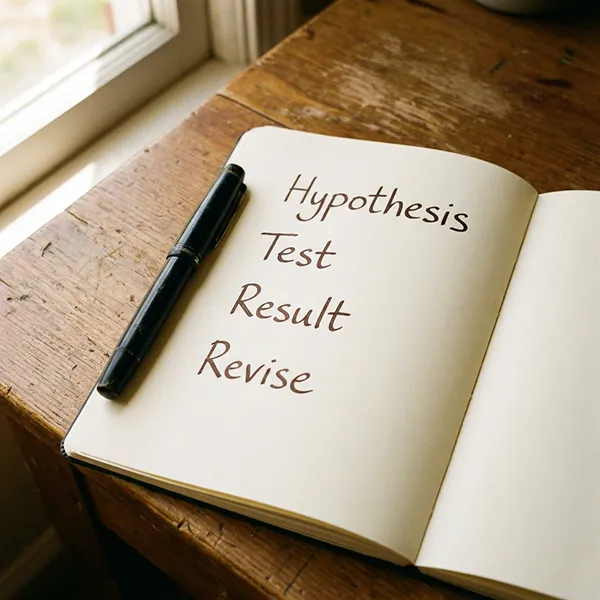
The Scientific Method Is a Life Skill Nobody Puts on Their Resume
I have sat across the table from a lot of very confident people who were completely wrong. Not dishonest — wrong. They had formed a view early, gathered evidence that supported it, and stopped there. The conclusion felt solid because they'd never properly tested it.
That is not a failure of intelligence. It is a failure of method. And it is almost universal.
The scientific method is taught in schools as a procedure for doing science. Four or five steps depending on who is writing the curriculum. Observation, hypothesis, experiment, result, conclusion. It appears in textbooks alongside diagrams. Students learn it well enough to reproduce it in an exam and then, largely, forget it exists.
This is a significant waste of something genuinely useful.
Because what the scientific method actually is — underneath the classroom framing — is a structured approach to not fooling yourself. And the need for that does not stop at the laboratory door.
Here is what the method does in practice, stated plainly.
It forces you to commit to what you think before you look at the evidence. A hypothesis is not a guess — it is a position. You are required to state what you expect to find and why, before you find it. This single requirement eliminates an enormous amount of the self-deception that passes for analysis in most professional settings. If you haven't stated what you expected before you got the result, you cannot honestly claim the result confirmed your thinking. You are just narrating backwards.
It separates the test from the conclusion. The result of an experiment is data. The conclusion is an interpretation of that data. Those are two different things, and keeping them separate is harder than it sounds when the result is not what you were hoping for.
It builds revision in as a feature, not a failure. When the result doesn't match the hypothesis, that is not a problem to be explained away — it is information. The method treats being wrong as a productive event. Most professional cultures treat it as something to be avoided, minimised, or quietly reassigned to someone else.
I spent thirty years watching decisions get made in organisations of every size and type. The pattern I saw most consistently was not incompetence. It was people skipping the hypothesis.
They would gather information, feel a conclusion forming, and act on it. Sometimes they were right — often enough to feel confident, not often enough to be reliable. The ones who were consistently right were the ones who, almost always without labelling it as such, were running something close to the scientific method. They stated what they thought before they looked. They tested it against evidence rather than collecting evidence for it. They revised when the data required it.
Nobody was putting that on their resume. Nobody was calling it the scientific method. But that is what it was.
Your training installs this process at a level below conscious thought. You repeat it enough times — state the expectation, run the procedure, observe the actual result, reconcile the two — that it starts to become the default way you approach a problem. Not just in a lab. Everywhere.
The person who has genuinely internalised this process approaches a business problem differently to the person who hasn't. They approach a personal decision differently. A disagreement. A diagnosis — medical, technical, or organisational. They ask what they actually expected before they started. They notice when the result doesn't match. They resist the urge to make the data fit the conclusion they arrived at too early.
That is not a minor cognitive upgrade. It is a fundamentally different way of engaging with uncertainty.
Most people list their technical skills on a resume. The software they can use. The instruments they can operate. The qualifications they hold.
Nobody lists "I have a reliable method for not fooling myself." Which is unfortunate, because in thirty years of working alongside highly credentialled people, it is the scarcest skill I have consistently encountered.
You are building it right now. It might be worth knowing that.