
Pattern Recognition: The Skill Every Lab Technician Is Building Without Knowing It
I once watched a senior network engineer walk into a data centre, glance at a rack of equipment, and say "that switch is about to fail" before running a single diagnostic. He was right. He couldn't fully articulate how he knew — something about the indicator pattern looked wrong to him in a way he had learned to trust.
That was not intuition. That was pattern recognition built across thousands of hours of looking at equipment that was working, and enough exposure to equipment that wasn't to know the difference at a glance.
The distinction matters more than most people realise.
Pattern recognition gets described, loosely, as a natural talent. Some people have it, some don't. This is mostly wrong, and it matters that it's wrong — because it leads people to discount a skill they are actively building and don't realise they possess.
Pattern recognition is not a gift. It is an accumulated database. It is the product of repeated, careful observation over time, in a domain where feedback is reliable enough that you learn which patterns mean something and which don't. The person who appears to have an instinct for spotting problems has usually just seen more problems — and paid close enough attention to remember what preceded them.
Your training is building that database right now.
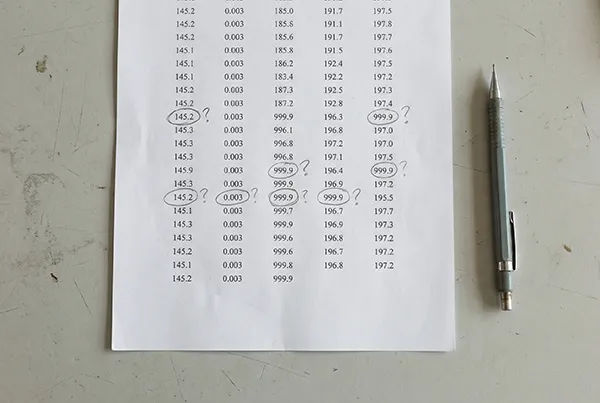
In a laboratory environment, you are exposed to an unusually high volume of results, samples, and outcomes — and crucially, you are trained to observe them carefully rather than process them mechanically. The technician who has run hundreds of analyses is not just faster than the one who has run ten. They see differently. They notice when something is slightly off before the numbers confirm it. They have a calibrated sense of what normal looks like, which means abnormal registers earlier and more reliably.
This is not magic. It is the predictable outcome of disciplined observation repeated at volume. The training environment you are in accelerates it by providing both the repetition and the feedback loop — you find out whether what you noticed was significant, which is the mechanism by which pattern recognition actually develops.
The broader application of this skill is something that tends to go unrecognised until someone points it out.
Every complex domain has patterns. Organisations have them — the specific combination of communication breakdowns and timeline pressure that precedes a project failure looks remarkably consistent once you have seen it enough times. Financial data has them. Clinical presentations have them. The behaviour of systems under stress — whether those systems are networks, supply chains, or teams — has them.
The person who has been trained to observe carefully, to notice variance, to distinguish signal from noise in a laboratory setting carries that observational discipline into every domain they subsequently work in. They are not pattern matching on the specific content — they are applying a general capacity for noticing that was developed in a specific context.
That transfer is real, and it is underestimated.
There is a version of pattern recognition that becomes a liability, and it is worth naming honestly.
A pattern observed in one context, applied too confidently in another, produces false matches. The experienced technician who has seen the same failure mode a hundred times will occasionally see it where it doesn't exist — because the brain is very good at finding what it is primed to look for. This is confirmation bias wearing the clothes of expertise.
The check on this is the same as the check on every cognitive shortcut your training is teaching you: go back to the evidence. The pattern is a hypothesis, not a conclusion. The data still has to confirm it.
That discipline — trusting the pattern enough to investigate, not trusting it enough to skip the investigation — is what separates reliable expert judgement from overconfident assumption. It is a fine line. Knowing it exists is most of the battle.
You are building something in your training that most people in most fields spend a decade trying to develop after the fact. A calibrated eye. A sense of what normal looks like in a high-precision environment. The observational discipline to notice when something deviates from it before the obvious signals arrive.
That is not a laboratory skill. It is a thinking skill that happens to be built in a laboratory.
Take it with you when you leave. It will be useful in places you haven't imagined yet.